Diamonds are evaluated using the universally accepted standard known as the 4Cs: Cut, Color, Clarity, and Carat weight, developed by GIA.
Understanding these elements empowers informed decisions, ensuring you select a stone reflecting both beauty and value, as detailed in comprehensive guides.
A 4Cs chart PDF provides a handy reference, simplifying the grading system and aiding in comparing different diamond options during your shopping journey.
What are the 4Cs?
The 4Cs – Cut, Color, Clarity, and Carat – represent the globally recognized standard for assessing diamond quality, initially created by the Gemological Institute of America (GIA). Each ‘C’ individually impacts a diamond’s appearance and ultimately, its value. A 4Cs chart PDF visually breaks down these complex characteristics, offering a simplified understanding for consumers.
Cut refers to how well a diamond’s facets interact with light, influencing brilliance, fire, and scintillation. Color grades the absence of color, with D being colorless and Z having a light yellow or brown tint. Clarity assesses the presence of inclusions (internal flaws) and blemishes (external imperfections). Finally, Carat measures the diamond’s weight, directly correlating to its size – though size and appearance aren’t always proportional.
Utilizing a 4Cs chart PDF allows for easy comparison of diamonds, helping you prioritize which characteristics are most important to you and your budget.
Why are the 4Cs Important?
Understanding the 4Cs – Cut, Color, Clarity, and Carat – is crucial for making an informed diamond purchase, ensuring you receive a stone that aligns with your expectations and budget. Without this knowledge, assessing value becomes incredibly difficult, leaving you vulnerable to overpaying or selecting a diamond that doesn’t meet your aesthetic preferences.
The 4Cs provide a standardized language for comparing diamonds, regardless of the retailer. A comprehensive 4Cs chart PDF serves as an invaluable tool, translating complex grading reports into easily digestible information. It empowers you to prioritize what matters most – perhaps maximizing brilliance with Cut, or achieving a certain size with Carat weight.
Ultimately, mastering the 4Cs, aided by resources like a 4Cs chart PDF, transforms you from a passive buyer into a confident, knowledgeable consumer.
Cut
Diamond Cut significantly impacts brilliance; a 4Cs chart PDF illustrates how proportions and symmetry affect light performance, influencing a stone’s overall beauty.
Understanding Diamond Cut Grades
Diamond cut grades, detailed within a comprehensive 4Cs chart PDF, are crucial for assessing a stone’s brilliance, fire, and scintillation. These grades—Excellent, Very Good, Good, Fair, and Poor—reflect how well a diamond’s facets interact with light.
An “Excellent” cut maximizes light return, creating exceptional sparkle, while “Poor” cuts often appear dull. A 4Cs chart PDF visually demonstrates the differences between these grades, showcasing ideal proportions and facet arrangements. Examining these charts helps understand how cut impacts a diamond’s visual appeal.
Furthermore, the chart clarifies the relationship between table percentage, depth percentage, and girdle thickness, all vital components of a well-cut diamond. Utilizing a 4Cs chart PDF empowers buyers to make informed decisions, prioritizing cut for optimal beauty and value, ensuring a dazzling gemstone.
Impact of Cut on Diamond Brilliance
A diamond’s brilliance—its ability to reflect white light—is profoundly influenced by its cut, as illustrated in a detailed 4Cs chart PDF. Precisely angled facets act like mirrors, bouncing light internally before returning it to the eye. An ideal cut maximizes this effect, creating exceptional sparkle and fire.
Poorly cut diamonds, often depicted in 4Cs chart PDF comparisons, allow light to leak through the bottom or escape from the sides, resulting in a dull appearance. The chart highlights how proportions—depth, table, and crown angle—affect light performance.
Understanding these relationships, facilitated by a 4Cs chart PDF, is vital. Symmetry also plays a role; well-aligned facets ensure even light distribution. Ultimately, cut is the most important of the 4Cs, directly impacting a diamond’s visual impact and overall beauty.
Cut Proportions and Symmetry
Diamond cut isn’t just about shape; it’s a precise science of proportions and symmetry, clearly visualized in a comprehensive 4Cs chart PDF. Key proportions—table percentage, depth percentage, crown angle, and pavilion angle—dictate how light interacts within the stone.
A 4Cs chart PDF demonstrates how deviations from ideal ranges can diminish brilliance. Symmetry refers to the precise alignment of facets. Polished diamonds with excellent symmetry exhibit superior light performance, while asymmetry can cause light leakage.

These elements are meticulously graded by gemological labs like GIA, with findings often summarized in a 4Cs chart PDF. Examining these details empowers buyers to assess a diamond’s quality beyond its visual appeal, ensuring optimal sparkle and fire.

Color

Diamond color, graded on a D-Z scale, impacts value; a 4Cs chart PDF visually explains this range.
Lower grades may exhibit a slight yellow tint, detailed in helpful 4Cs chart PDF resources.
The Diamond Color Scale (D-Z)
The diamond color scale, ranging from D to Z, assesses how white or colorless a diamond appears. A 4Cs chart PDF is invaluable for understanding this grading system, as it visually represents the subtle differences in color.
Diamonds graded D-F are considered colorless and represent the highest quality, commanding premium prices. Grades G-J appear nearly colorless and offer excellent value, often looking colorless to the untrained eye. As you move down the scale towards K-Z, diamonds exhibit a noticeable yellow or brown tint.
A detailed 4Cs chart PDF will showcase images of diamonds at various color grades, allowing for easy comparison. It’s important to note that color is graded under controlled lighting conditions, and slight variations can occur. The scale is based on how much yellow or brown hue is present, with D being completely absent of color. Utilizing a 4Cs chart PDF during your selection process ensures clarity and informed decision-making.
Near Colorless vs. Light Color Diamonds
Distinguishing between near colorless (G-J) and light color (K-M) diamonds is crucial for maximizing value, and a 4Cs chart PDF provides a helpful visual aid. Near colorless diamonds appear white when mounted, offering a balance between quality and affordability.
Light color diamonds exhibit a faint yellow tint, which may be more noticeable depending on the setting. These stones are often a cost-effective option, particularly for yellow or rose gold settings where the tint is less apparent. A comprehensive 4Cs chart PDF will illustrate the subtle color differences, allowing for direct comparison.
When reviewing a 4Cs chart PDF, consider the intended setting. For platinum or white gold, a higher color grade (D-H) is recommended. However, for warmer metals, a lower grade (J-L) can still appear beautiful. Understanding these nuances, aided by a 4Cs chart PDF, empowers you to make an informed choice aligned with your preferences and budget.
Color and Diamond Value
Diamond color significantly impacts its value, with colorless diamonds (D-F) commanding the highest prices. As color decreases – moving down the scale towards Z – value generally diminishes, as detailed in a reliable 4Cs chart PDF.
The price difference between color grades can be substantial. A D color diamond will be significantly more expensive than a G or H color stone of similar carat weight, cut, and clarity. A 4Cs chart PDF visually demonstrates these price variations, aiding in budget planning.
However, the impact of color on value is also influenced by other factors. A well-cut diamond can mask slight color imperfections, making a lower color grade appear brighter. Consulting a 4Cs chart PDF alongside expert advice ensures you understand the interplay between color and overall diamond quality, maximizing your investment.

Clarity
Diamond clarity, assessed by the GIA, ranges from Flawless to Included, impacting brilliance and value; a 4Cs chart PDF illustrates these grades.
Understanding inclusions and blemishes, as shown in a chart, is crucial for informed selection.
Diamond Clarity Grades (FL-I3)
Diamond clarity grades, meticulously defined by the GIA, represent the absence of inclusions and blemishes, significantly influencing a stone’s beauty and price.
FL (Flawless) diamonds possess no internal inclusions or external blemishes visible under 10x magnification – exceptionally rare and valuable.
IF (Internally Flawless) diamonds have no internal inclusions, though minor blemishes may be present on the surface.
VVS1 & VVS2 (Very, Very Slightly Included) exhibit minute inclusions difficult to detect even with 10x magnification.
VS1 & VS2 (Very Slightly Included) contain minor inclusions noticeable with effort under 10x magnification.
SI1 & SI2 (Slightly Included) inclusions are noticeable under 10x magnification and may be visible to the naked eye.
I1, I2 & I3 (Included) diamonds have obvious inclusions visible to the naked eye, impacting brilliance and typically costing less.
A comprehensive 4Cs chart PDF visually represents these grades, aiding in understanding and comparison, allowing informed purchasing decisions.
Types of Diamond Inclusions
Diamond inclusions are internal characteristics formed during the stone’s creation, impacting clarity and value. Understanding these helps assess a diamond’s unique fingerprint.
Feathers are tiny fractures within the diamond, often resembling wispy feathers; their proximity to the surface affects durability.
Crystals are internal mineral deposits, differing in color and reflectivity, sometimes enhancing a diamond’s sparkle.
Clouds are dense clusters of pinpoint inclusions, diminishing brilliance if substantial.
Needles are long, thin inclusions, potentially affecting light performance.
Pinpoints are tiny, isolated inclusions, generally less impactful on clarity.
Cavities are larger, open inclusions, potentially weakening the diamond.
External blemishes, like scratches or polish lines, also affect clarity. A detailed 4Cs chart PDF often illustrates these inclusion types, providing visual examples for better comprehension and informed selection during your diamond shopping process.
Clarity’s Effect on Appearance
A diamond’s clarity significantly impacts its brilliance and overall aesthetic appeal; While flawless diamonds are rare and expensive, most have minor inclusions visible under magnification.
Higher clarity grades (FL-VS) generally appear eye-clean, meaning inclusions aren’t visible to the naked eye, maximizing light performance.
Lower clarity grades (SI2-I3) may exhibit visible inclusions, potentially affecting brilliance and transparency, though not always detracting from beauty.
The size, number, position, and nature of inclusions all contribute to how clarity affects appearance.
Larger or darker inclusions are more noticeable, while smaller, lighter ones are less impactful.
A 4Cs chart PDF visually demonstrates how different clarity grades translate to visible characteristics, aiding in assessing the balance between clarity, price, and aesthetic preference. It helps determine if a slightly included diamond still offers exceptional beauty.
Carat
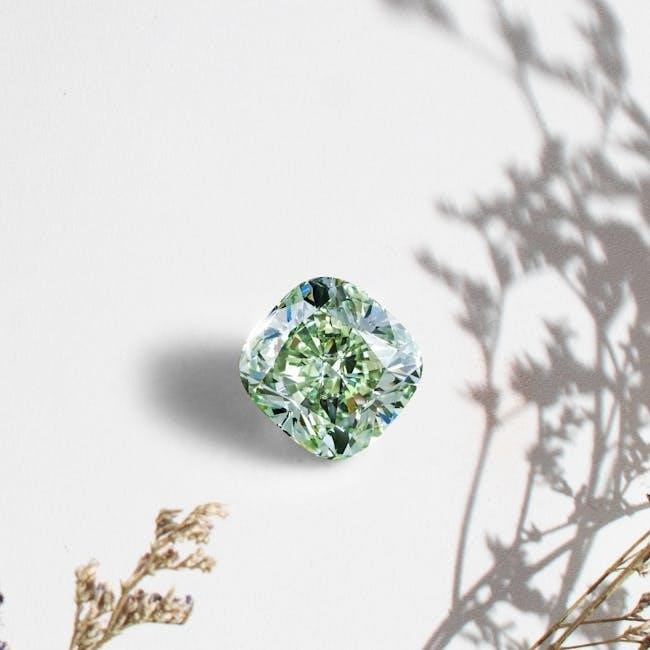
Carat refers to a diamond’s weight, directly influencing its price; a 4Cs chart PDF illustrates how carat relates to size and value considerations.
Understanding Diamond Carat Weight
Diamond carat weight measures a stone’s weight, not its size, with one carat equaling 200 milligrams. A 4Cs chart PDF visually demonstrates how carat impacts cost, as larger carats are rarer and therefore more expensive.

However, it’s crucial to remember that carat weight doesn’t tell the whole story; two diamonds of the same carat weight can vary significantly in price based on the other 3Cs – Cut, Color, and Clarity.
A well-cut, smaller carat weight diamond can appear larger and more brilliant than a poorly cut, larger stone. Therefore, consulting a 4Cs chart PDF alongside considering all four factors is essential for making an informed purchase. These charts often provide price ranges for different carat weights and quality grades, offering a helpful benchmark.
Understanding carat weight empowers you to prioritize what matters most – whether it’s maximizing size within a budget or focusing on overall brilliance and quality.
Carat vs. Size – What’s the Difference?
While often used interchangeably, carat refers to weight, and size refers to visual appearance. A 4Cs chart PDF can illustrate this distinction, showing how different cut grades affect a diamond’s face-up area – its visible size – even with the same carat weight.
A poorly cut diamond, even with a higher carat weight, can appear smaller due to its depth and proportions. Conversely, an expertly cut stone can maximize its brilliance and appear larger than its actual weight suggests.
Therefore, focusing solely on carat weight when comparing diamonds can be misleading. A 4Cs chart PDF helps visualize how cut, alongside carat, influences perceived size. It’s vital to consider millimeter measurements (diameter) alongside carat weight to accurately assess a diamond’s visual impact.
Prioritizing cut quality often yields a more visually impressive stone than simply opting for a higher carat weight.
Carat and Price Relationship
Generally, diamond price increases with carat weight, but the relationship isn’t linear. A 4Cs chart PDF often demonstrates price jumps at key weight milestones – for example, moving from 0.99 carats to 1.00 carat can significantly increase the cost.
This is because these milestone weights are considered more desirable by consumers. Larger, rarer diamonds command a premium, but price per carat actually increases as size grows. A 2-carat diamond won’t simply cost twice as much as a 1-carat diamond of similar quality.
A 4Cs chart PDF can help illustrate these price points. Understanding this pricing structure allows for strategic shopping; sometimes, a slightly smaller diamond, just below a key milestone, offers excellent value.
Remember, the 4Cs – Cut, Color, Clarity – also heavily influence price, alongside carat weight.

GIA and the 4Cs
GIA developed the 4Cs standard and the International Diamond Grading System, ensuring consistent evaluation; a 4Cs chart PDF reflects this.
GIA reports provide detailed assessments, vital for informed purchasing decisions.
GIA’s Role in Diamond Grading
GIA (Gemological Institute of America) stands as the leading authority in diamond grading, establishing the standards by which these precious gemstones are evaluated globally.
Their pivotal role centers around objective analysis, utilizing sophisticated equipment and highly trained gemologists to assess the 4Cs – Cut, Color, Clarity, and Carat weight – with unwavering consistency.
A 4Cs chart PDF, often based on GIA’s grading scales, serves as a valuable tool for consumers, translating complex gemological terminology into understandable criteria.
GIA doesn’t just grade; they research, educate, and protect the public interest, ensuring trust and transparency within the diamond industry.
Their grading reports, accompanying certified stones, provide a detailed ‘fingerprint’ of the diamond, confirming its authenticity and quality, aligning perfectly with information found in a comprehensive 4Cs chart PDF.
This commitment to scientific rigor and unbiased assessment solidifies GIA’s position as the ultimate arbiter of diamond value.
The International Diamond Grading System
The International Diamond Grading System, pioneered by GIA, provides a standardized language for evaluating diamond quality, ensuring consistency across the globe.
This system meticulously assesses the 4Cs – Cut, Color, Clarity, and Carat – using precise scales and defined criteria, eliminating subjective interpretations.
A 4Cs chart PDF visually represents this system, offering a clear understanding of each grade within each category, from D (colorless) to Z (light yellow) and FL (flawless) to I3 (included).
The system’s adoption by reputable laboratories worldwide fosters trust and transparency in the diamond trade, benefiting both buyers and sellers.
Understanding this grading system, often aided by a detailed 4Cs chart PDF, empowers consumers to make informed purchasing decisions based on objective assessments.
It’s the foundation for comparing diamonds and determining their relative value, ensuring a fair and equitable transaction.
GIA Diamond Reports & Certificates
GIA Diamond Reports and Certificates are comprehensive assessments of a diamond’s 4Cs, providing an unbiased and authoritative evaluation of its quality.
These reports detail the diamond’s Cut, Color, Clarity, and Carat weight, along with precise measurements, plot diagrams illustrating inclusions, and a unique report number.
A 4Cs chart PDF can be a valuable companion when reviewing a GIA report, helping to visualize the grading scale and understand the significance of each characteristic.
GIA reports are considered the gold standard in the industry, offering assurance of authenticity and providing essential information for insurance purposes.
They are crucial for verifying a diamond’s value and ensuring you are receiving a stone that matches its described qualities.
Utilizing both a GIA report and a 4Cs chart PDF empowers buyers with the knowledge to make confident and informed decisions.

4Cs Chart PDF Resources
Numerous online sources offer free 4Cs chart PDF downloads, simplifying diamond grading comprehension.
These charts visually represent the scales for Cut, Color, Clarity, and Carat, aiding informed purchasing decisions.
GIA also provides resources, ensuring accuracy and reliable diamond education.
Where to Find Reliable 4Cs Charts
Finding trustworthy 4Cs chart PDF resources is crucial for accurate diamond education. The Gemological Institute of America (GIA) website is a premier source, offering comprehensive charts and guides directly reflecting their grading standards; Reputable online jewelers, like James Allen and Blue Nile, often provide downloadable 4Cs charts as part of their educational content, ensuring alignment with industry best practices.
Beware of generic charts from unknown sources, as they may contain inaccuracies or outdated information. Look for charts that clearly define each of the 4Cs – Cut, Color, Clarity, and Carat – with detailed explanations and visual representations of the grading scales. Prioritize resources that emphasize the GIA grading system, as it’s the globally recognized standard. A reliable chart will also illustrate common diamond inclusions and their impact on clarity, helping you make an informed decision.
Always cross-reference information from multiple sources to confirm accuracy and gain a well-rounded understanding of diamond quality.
Using a 4Cs Chart for Diamond Shopping
A 4Cs chart PDF is an invaluable tool when navigating the diamond market. Before you begin, familiarize yourself with each category – Cut, Color, Clarity, and Carat – understanding how each impacts a diamond’s appearance and price. When comparing stones, use the chart to objectively assess their grades, avoiding solely relying on salesperson descriptions.
The chart helps prioritize your preferences; for example, if brilliance is key, focus on Cut grades. It also aids in understanding trade-offs – perhaps accepting a slightly lower Clarity grade to afford a larger Carat weight. When reviewing diamond certificates, cross-reference the grades with your 4Cs chart to verify consistency and accuracy.
Remember, the 4Cs are interconnected; a well-cut diamond can mask minor Clarity imperfections. A chart empowers you to make informed decisions, ensuring you select a stone that aligns with your budget and aesthetic preferences.
Benefits of a PDF Chart Format
Choosing a 4Cs chart in PDF format offers several practical advantages for diamond shoppers. PDFs are universally accessible, viewable on any device – smartphones, tablets, or computers – without requiring special software. This portability allows you to have the chart readily available during appointments with jewelers or while browsing online.
Unlike online charts, PDFs maintain consistent formatting across different platforms, ensuring accurate visual representation of the grading scales. They are also easily downloadable and savable for future reference, creating a permanent record of your research. Furthermore, PDFs can be printed, providing a tangible resource for note-taking and comparison.
A well-designed 4Cs chart PDF consolidates essential information in a concise, organized manner, simplifying the complex world of diamond grading and empowering confident purchasing decisions.